
ORIGINAL ARTICLE
Revisiting Graminocarpon, a distinctive monocot
seed from the latest Cretaceous
Deccan Intertrappean beds of India
1
Florida Museum of Natural History, Dickinson Hall, Gainesville, Florida 32611-7800, USA
2
Department of Botany, Jashbhai Muljibhai Patel College, Bhandara, 441904-M.S, India
3
Department of Ecology and Evolutionary Biology, University of Kansas, Lawrence, Kansas 66045, USA;
and Biodiversity Institute, University of Kansas, Lawrence, Kansas 66045, USA
4
Post Graduate Department of Botany, Rashtrasant Tukadoji Maharaj Nagpur University, Nagpur, India
5
Gondia Education Society High School and Junior College, Mohadi. Dist., Gondia, 4416014-M.S., India
6
School of Plant Sciences and Food Security, Faculty of Life Sciences, Tel Aviv University, Tel Aviv 6997801,
Israel
7
Department of Earth and Environmental Sciences, University of Michigan, Ann Arbor, Michigan 48109,
USA
Submission date: 2025-12-27
Acceptance date: 2026-04-02
Online publication date: 2026-06-29
Publication date: 2026-06-29
Acta Palaeobotanica 2026; 66(1): 83-94
HIGHLIGHTS
- Graminocarpon is known from several late Cretaceous sites in central India
- Graminocarpon is not a grass and not a fruit
- Micro-CT scanning reveals similarities and differences from seeds of palms
KEYWORDS
ABSTRACT
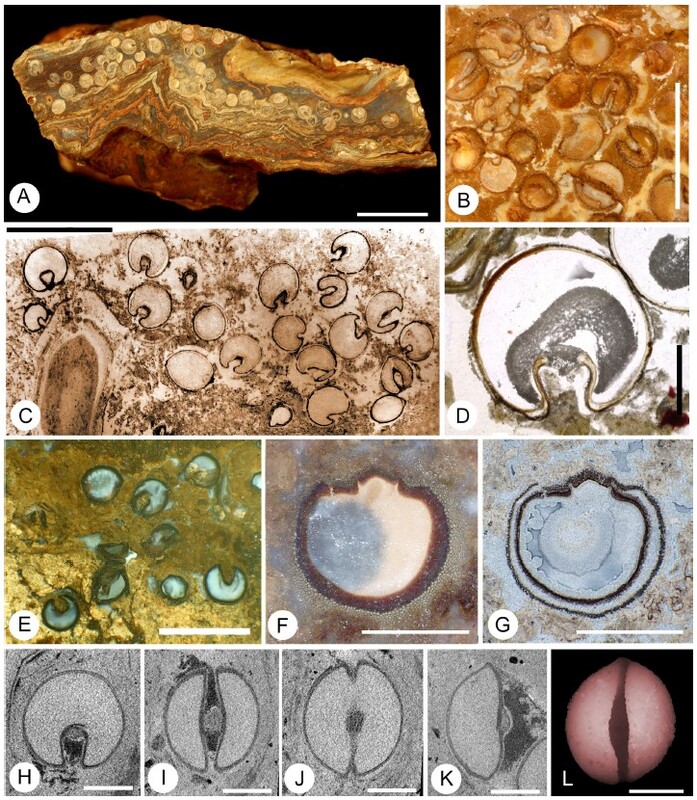
Disseminules of Graminocarpon Chitaley et Sheikh, found at several sites of the Deccan intertrappean
cherts in central India, have been reinvestigated based on physical thin sectioning and peeling and by X-ray
micro-CT scanning. The globose seeds, measuring 2 to 2.5 mm in diameter, with a prominent furrow on one side
and the apparent circular hilum in the center of the furrow, have a thin seed coat composed of two cell layers.
The straight cylindrical embryo with no evidence of plumule differentiation is obliquely positioned in the plane
of symmetry on the side opposite the furrow and is capped by a circular operculum. The combined morphological
features support its recognition as a monocot, but exclude it from the Gramineae/Poaceae. Secure systematic
placement is difficult, however, as we failed to find a direct match among extant taxa. The general geometry of
the seeds, and position of the embryo and embryo cap presents similarities with the Arecaceae. However, the
fossil appears to be unique among monocots, not readily attributed to a modern clade.
FUNDING
Field work for this project was
supported in part by National Science Foundation
grants to S.Y. Smith (EAR 1338295) and
S.R. Manchester (EAR 1338285). The resource
of extant comparative palm fruits and seeds
used for this study was supported by National
Science Foundation Doctoral Dissertation
Improvement Grant to K.K.S.M. and S.Y.S.
(DEB 1701645).
CONFLICT OF INTEREST
The authors
have declared that no competing interests exist.
REFERENCES (38)
1.
Agarwal, A., 2008. Angiospermous fossil fruits/seeds during Tertiary in India. The Palaeobotanist 57, 165–175. https://doi.org/10.54991/jop.2....
2.
Benedict, J.C., Smith, S.Y., Specht, C.D., Collinson, M.E., Leong-Škorničková, J., Parkinson, D.Y., Marone, F., 2016. Species diversity driven by morphological and ecological disparity: a case study of comparative seed morphology and anatomy across a large monocot order. AoB Plants 8, plw063. https://doi.org/10.1093/aobpla....
3.
Biradar, N.V., Mahabale, T.S., 1969. Studies on palms: fruits, seeds and seed germination in the genus Phoenix L. Proceedings of the Indian Academy of Sciences 70(2), 55–65. https://doi.org/10.1007/BF0305....
4.
Chitaley, S.D., Sheikh, M.T., 1971. An infected grain from the Deccan intertrappean cherts of Mohgaonkalan. Journal of the Indian Botanical Society 50, 137–142.
5.
Coan, A.I., 2006. Embriologia e desenvolvimento de frutos e sementes de Eriocaulaceae e Cyperaceae (Poales). Thesis presented to the Institute of Biosciences of the Rio Claro Campus, São Paulo State University, as part of the requirements for obtaining the title of Doctor of Biological Sciences. http://hdl.handle.net/11449/10....
6.
Collinson, M.E., 1980. Recent and Tertiary seeds of the Nymphaeaceae sensu lato with a revision of Brasenia ovula (Brong.) Reid and Chandler. Annals of Botany 46(5), 603–632.
7.
Dighe, S.W., Kokate, P.S., 2016. Coffeocarpon deccanii gen. et. sp. nov. A new petrified dicotyledonous berry fruit from the Deccan Intertrappean Beds of Central India. International Journal of Scientific Research 5, 275–277.
8.
Danilova, M.F., Savchenko, M.I., 1985. Arecaceae. Pp. 236-253. In: Takhtajan, A., (ed.), Anatomia Seminum Comparativa, Tomus 1, Liliopsida seu Monocotyledons. Nauka, Leningrad, 320 pp.
9.
Dutta, D., Ambwani, K., 2005. A fossil caryopsis from the Deccan Intertrappean Beds (Upper Cretaceous) of Mohgaon Kalan, Chhindwara. District, Madhya Pradesh, India. Phytomorphology 55(1–2), 29–32.
10.
Dransfield, J., Uhl, N.W., Asmussen, C.B., Baker, W.J., Harley, M.M., Lewis, C.E., 2008. Genera Palmarum: the evolution and classification of palms. Kew Publishing, Richmond, Surrey, UK. 732 pp.
11.
Grootjen, C.J., Bouman, F., 1981a. Development of the ovule and seed in Costus cuspidatus (Zingiberaceae), with special reference to the formation of the operculum. Botanical Journal of the Linnean Society 83(1), 27–39. https://doi.org/10.1111/j.1095....
12.
Grootjen, C.J., Bouman, F., 1981b. Development of ovule and seed in Stanfieldiella imperforata (Commelinaceae). Acta Botanica Neerlandica 30(4), 265–275. https://doi.org/10.1111/j.1438....
13.
Hamersma, A.M., Karumanchi, C., Kapgate, D., Pigg, K.B., Smith, S.Y., Graham, S.A., Manchester, S.R., 2025. Revision of the fossil flower genus Sahnianthus Shukla (Myrtales) from the latest Cretaceous Deccan Intertrappean Beds of India. Acta Palaeobotanica 65(1), 98–121. https://doi.org/10.35535/acpa-....
14.
Iossi, E., Moro, F.V, Sader, R., 2006. Seed anatomy and germination of Phoenix roebelenii O’Brien (Arecaceae). Revista Brasileira de Sementes 28, 121–128. https://doi.org/10.1590/S0101-....
15.
Kapgate, D.K., 2012. Report of a caryopsis grains from the Deccan Intertrappean cherts of central India. The Botanique 16, 18–22.
16.
Kapgate, D.K., Awasthi, N., Manchester, S.R., Chitaley, S., 2011. Inflorescence and flowers of Sahnipushpam Shukla from the Deccan Intertrappean beds of India. Acta Palaeobotanica 51(2), 207–227.
17.
Manchester, S.R., Bonde, S.D., Nipunage, D.S., Srivastava, R., Mehrotra, R.C., Smith, S.Y., 2016. Trilocular palm fruits from the Deccan Intertrappean Beds of India. International Journal of Plant Sciences 177, 633–641. https://doi.org/10.1086/687290.
18.
Manchester, S.R., Kapgate, D.K., Ukey, R.W., Wanjari, M.H., 2022. Infructescences, fruits and seeds of the distinctive fossil palm, Tricoccites trigonum K.P. Rode from Mohgaonkalan in Chhindwara District, Madhya Pradesh, India: three-dimensional morphology, and anatomy. Geophytology 50, 49–60.
19.
Matsunaga, K.K., Smith, S.Y., 2021. Fossil palm reading: using fruits to reveal the deep roots of palm diversity. American Journal of Botany 108(3), 472–494. https://doi.org/10.1002/ajb2.1....
20.
Matsunaga, K.S., Smith, S.Y., Manchester, S.R., Kapgate, D., Ramteke, D., Garbout, A., Villarraga-Gómez, H., 2018. Reinvestigating an enigmatic Late Cretaceous monocot: morphology, taxonomy, and biogeography of Viracarpon. PeerJ 6, e4580. https://doi.org/10.7717/peerj.....
21.
Matsunaga, K.K., Manchester, S.R., Srivastava, R., Kapgate, D.K., Smith, S.Y., 2019. Fossil palm fruits from India indicate a Cretaceous origin of Arecaceae tribe Borasseae. Botanical Journal of the Linnean Society 190(3), 260–280. https://doi.org/10.1093/botlin....
22.
Nardi, K.D.O., 2018. Embriogênese e desenvolvimento pós-seminal de Xyridaceae e Mayacaceae e anatomia floral de Xyris, com ênfase na evolução de caracteres. Thesis presented to the Institute of Biosciences of the Rio Claro Campus, São Paulo State University, as part of the requirements for obtaining the Doctorate degree in Biological Sciences (Plant Biology).
23.
Nardi, K.D.O., Scatena, V.L., Oriani, A., 2015. Development of ovule, fruit and seed of Xyris (Xyridaceae, Poales) and taxonomic considerations. Botanical Journal of the Linnean Society 177(4), 619–628. https://doi.org/10.1111/boj.12....
24.
Netolitzky, F., 1926 Anatomie der Angiospermen-Samen. In: Linsbauer, K. (ed.), Handbuch der Pflanzenanatomie. II. Abteilung 2. Teil: Pterodophyten und Anthophyten. Band X. Verlag von Gebrüder Borntraeger, Berlin.
25.
Pérez, H.E., 2009. Promoting germination in ornamental palm seeds through dormancy alleviation. HortTechnology 19(4), 682–685.
26.
Petrova, L.R., Fedotova, T.A., Nikolaevskaya, T.S., 1985. Poaceae. In: Takhtajan, A., (ed.), Anatomia Seminum Comparativa, Tomus 1, Liliopsida seu Monocotyledons. Nauka, Leningrad, pp. 192–205.
27.
Prasad, V., Strömberg, C.A.E., Leaché, A.D., Samant, B., Patnaik, R., Tang, L., Mohabey, D.M., Ge, S., Sahni, A., 2011. Late Cretaceous origin of the rice tribe provides evidence for early diversification in Poaceae. Nature Communications 2(1), 1–9. https://doi.org/10.1038/ncomms....
28.
Robertson, B.L., 1977. Morphology and development of the fruit and seed of Jubaeopsis caffra Becc. Principes 21, 23–30.
29.
Rudall, P.J., 1997. The nucellus and chalaza in monocotyledons: structure and systematics. Botanical Review 63(2), 140–181.
30.
Rudall, P.J., Sajo, M.G., 1999. Systematic position of Xyris: flower and seed anatomy. International Journal of Plant Sciences 160(4), 795–808. https://doi.org/10.1086/314162.
31.
Shamrov, I.I., 1988. Formation of hypostase, podium and postament in the ovule of Nuphar lutea (Nymphaeaceae) and Ribes aureum (Grossulariaceae). Botanicheskiy Zhurnal 83(1), 3–14.
32.
Shamrov, I.I., 2008. Ovule of seed plants: structure, functions, origin. Moscow: KMK Scientific Press.
33.
Smith, S.Y., Manchester, S.R., Samant, B., Mohabey, D.M., Wheeler, E.A., Baas, P., Kapgate, D., Srivastava, R., Sheldon, N.D., 2015. Integrating paleobotanical, paleosol, and stratigraphic data to study critical transitions: a case study from the Late Cretaceous-Paleocene of India. The Paleontological Society Papers 21, 137–166. https://10.1017/S1089332600002...
34.
Smith, S.Y., Kapgate, D.K., Robinson, S., Srivastava, R., Benedict, J.C., Manchester, S.R., 2021. Fossil fruits and seeds of Zingiberales from the Late Cretaceous-Early Cenozoic Deccan Intertrappean Beds of India. International Journal of Plants Sciences 182(2), 91–108. https://doi.org/10.1086/711474.
35.
Sokoloff, D.D., Remizowa, M.V., Beer, A.S., Yadav, S.R., Macfarlane, T.D., Ramsay, M.M., Rudall, P.J., 2013. Impact of spatial constraints during seed germination on the evolution of angiosperm cotyledons: a case study from tropical Hydatellaceae (Nymphaeales). American Journal of Botany 100(5), 824–843. https://doi.org/10.3732/ajb.12...
36.
Takhtajan, A., (ed.) 1985. Anatomia Seminum Comparativa Tomus 1, Liliopsida seu Monocotyledons. Nauka, Leningrad. 320 pp.
37.
Tilton, V.R., 1980. Hypostase development in Ornithogalum caudatum (Liliaceae) and notes on other types of modifications in the chalaza of angiosperm ovules. Canadian Journal of Botany 58, 2059–2066.
38.
Tschirch, A., 1891. Physiologische studien über die samen, insbesondere die Saugorgane derselben. Annales du Jardin Botanique de Buitenzorg 9, 143–183.
Share
RELATED ARTICLE
| eISSN: | 2082-0259 |
| ISSN: | 0001-6594 |


We process personal data collected when visiting the website. The function of obtaining information about users and their behavior is carried out by voluntarily entered information in forms and saving cookies in end devices. Data, including cookies, are used to provide services, improve the user experience and to analyze the traffic in accordance with the Privacy policy. Data are also collected and processed by Google Analytics tool (more).
You can change cookies settings in your browser. Restricted use of cookies in the browser configuration may affect some functionalities of the website.
You can change cookies settings in your browser. Restricted use of cookies in the browser configuration may affect some functionalities of the website.