
ORIGINAL ARTICLE
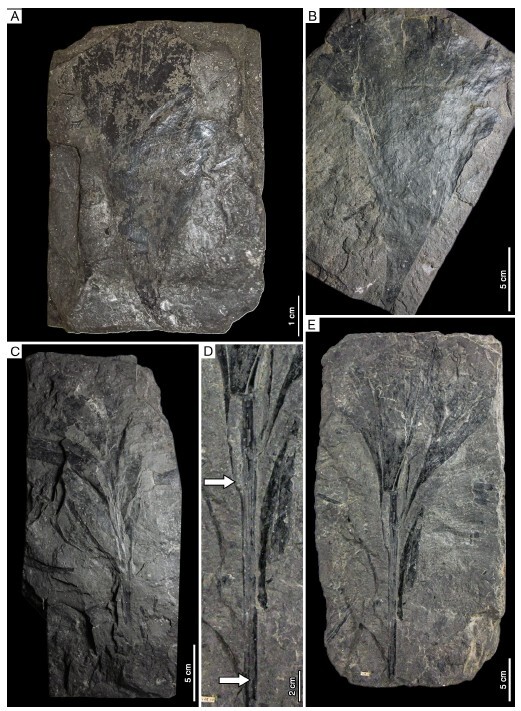
Ginkgophytopsis Høeg 1967 emend., a reclassification of enigmatic cuneate leaves of the Euramerican Upper Carboniferous
1
Geological Collections, Gantz Family Collections Center, Field Museum of Natural History, Chicago, Illinois,
60605, USA
2
Department of Paleobiology, National Museum of Natural History, Washington, D.C., 20560, USA
3
Institute of Geology and Palaeontology, Paleobotany Group, University of Münster, Münster, D-48149,
Germany
Submission date: 2026-02-01
Acceptance date: 2026-06-09
Online publication date: 2026-06-29
Publication date: 2026-06-29
Acta Palaeobotanica 2026; 66(1): 95-112
HIGHLIGHTS
- Taxonomic reassessment of Late Paleozoic “ginkgophyte” leaves from Euramerica
- Analysis of G. flabellatum in the context of Pennsylvanian Subperiod cyclothems
- Emendation of the genus Ginkgophytopsis to exclude species with true petioles
KEYWORDS
ABSTRACT
In Upper Carboniferous Euramerican floras, the generic affinities of enigmatic, cuneate to flabellate
“Ginkgo-like” leaves remain poorly understood. The species Cordaites grandifolius (USA), Noeggerathia
flabellata (U.K.) and Ginkgophyllum delvalii (Western and Central Europe) have been taxonomically studied
and compared, but no formal reclassification nor assessment of the North American form in relation to the
European specimens has been conducted prior to this study. Reinvestigation of the holotypes and additional
material of these species indicates that they do not conform to their current generic assignments on the basis of
laminar morphology, axis structure and paleogeographic range. Here, we synonymize the three aforementioned
species under the name Ginkgophytopsis flabellata, which we also emend. This study summarizes the complex
taxonomic history of some of the Late Paleozoic “ginkgophytes,” and we also emend the genus Ginkgophytopsis
on the basis of our morphological reassessment of G. flabellata.
FUNDING
This study was supported by
the Paleontological Society Norman Newell
Early Career Grant to Michael P. Donovan.
CONFLICT OF INTEREST
The authors
have no conflicts of interest to declare.
REFERENCES (77)
1.
Arber, E.A.N., 1912. On Psygmophyllum majus sp. nov., from the Lower Carboniferous rocks of Newfoundland, together with a revision of the genus and remarks on its affinities. Transactions of the Linnean Society of London, Series 2 (Botany) 7(18), 391–407. https://doi.org/10.1111/j.1095....
2.
Arber, E.A.N., 1913. A preliminary note on the fossil plants of the Mt. Potts Beds, New Zealand, collected by Mr. D. G. Lillie, biologist to Captain Scott’s Antarctic Expedition in the “Terra Nova”. Proceedings of the Royal Society of London B 86, 344–347. https://doi.org/10.1098/rspb.1....
3.
Archangelsky, S., Cúneo, R., 1990. Polyspermophyllum, a new Permian gymnosperm from Argentina, with considerations about the Dicranophyllales. Review of Paleobotany and Palynology 63, 117–135. https://doi.org/10.1016/0034-6....
4.
Arnold, C.A., 1949. Fossil flora of the Michigan coal basin. Contributions from the Museum of Paleontology, University of Michigan 7(9), 131–269.
5.
Asama, K., 1967. Permian plants from Maiya, Japan. 1. Cathaysiopteris and Psygmophyllum. Bulletin of the National Science Museum, Tokyo 10(2), 139–153.
6.
Bashforth, A.R., DiMichele, W.A., Eble, C.F., Nelson, W.J., 2016. Dryland vegetation from the Middle Pennsylvanian of Indiana (Illinois Basin): the dryland biome in glacioeustatic, paleobiogeographic, and paleoecologic context. Journal of Paleontology 90(5), 785–814. https://doi.org/10.1017/jpa.20....
7.
Bashforth, A.R., DiMichele, W.A., Eble, C.F., Falcon-Lang, H.J., Looy, C.V., Lucas, S.G., 2021. The environmental implications of upper Paleozoic plant-fossil assemblages with mixtures of wetland and drought-tolerant taxa in tropical Pangaea. Geobios 68, 1–45. https://doi.org/10.1016/j.geob....
8.
Bauer, K., Kustatscher, E., Krings, M., 2013. The ginkgophytes from the German Kupferschiefer (Permian), with considerations on the taxonomic history and use of Baiera and Sphenobaiera. Bulletin of Geosciences 88(3), 539–556. https://doi.org/10.3140/bull.g....
9.
Brongniart, A., 1845. Végétaux du système permien. In: Murchison, R.I., Verneuil, E. (eds), Géologie de la Russie d’Europe et des montagnes de l’Oural. Vol. 2. London. John Murray.
10.
Burago, V.I., 1967. On the floristic relationships between the western and eastern parts of Angarida in the Permian. Paleontologicheskii Zhurnal 1, 94–103.
11.
Burago, V.I., 1977. New combination Ginkgophytopsis gigantea Burago, comb. nov. Paleontologicheskii Zhurnal 1, 142.
12.
Bureš, J., Šimůnek, Z., Pšenička, J., Bek, J., Drábková, J., Bruthansová, J., 2023. Fertile cordaitalean leafy branch with in situ pollen from the volcanic Whetstone Horizon (Radnice Member, early Moscovian, Plzeň Basin, Czech Republic). Review of Paleobotany and Palynology 315, 1–25. https://doi.org/10.1016/j.revp....
13.
Cambier, R., Renier, A., 1910. Psygmophyllum Delvali n. sp. du Terrain houiller de Charleroi. Annales de la Société Géologique de Belgique 2, 21–34.
14.
Carruthers, W., 1872. Notes on fossil plants from Queensland, Australia. Quarterly Journal of the Geological Society of London 28, 350–359.
15.
Cecil, C.B., 2003. The concept of autocyclic and allocyclic controls on sedimentation and stratigraphy, emphasizing the climatic variable. SEPM Special Publication 77, 13–20. https://doi.org/10.2110/pec.03....
16.
Cecil, C.B., DiMichele, W.A., Elrick, S.D., 2014. Middle and Late Pennsylvanian cyclothems, American Midcontinent: Ice-age environmental changes and terrestrial biotic dynamics. Comptes Rendus Géoscience 346, 159–168. https://doi.org/10.1016/j.crte....
17.
Césari, S.N., Hünicken, M., 1992. Velizia inconstans gen. et sp. nov., a new gymnosperm from the Late Paleozoic of Argentina. Palaeontographica Abt. B 224(4–6), 121–129.
18.
Darrah, W.C., 1969. A critical review of the Upper Pennsylvanian floras of eastern United States with notes on the Mazon Creek flora of Illinois. Gettysburg College.
19.
Dawson, J.W., 1861. Scientific Survey. In: Hitchcock, C.H. (ed.), General report upon the geology of Maine. Sixth Annual Report of the Maine Board of Agriculture, pp. 247–257.
20.
Dawson, J.W., 1882. The fossil plants of the Erian (Devonian) and Upper Silurian formations of Canada, part II. Geological Survey of Canada, Separate Report 429, 57. Gazette Printing Company. https://doi.org/10.4095/216074.
21.
Decombeix, A.L., Escapa, I.H., De Franceschi, D., Béthoux, O., 2021. Reinvestigation of the type specimen of Ginkgophyllum Saporta 1875 using Reflectance Transforming Imaging. Review of Paleobotany and Palynology 295. https://doi.org/10.1016/j.revp....
22.
DiMichele, W.A., 2014. Wetland-dryland vegetational dynamics in the Pennsylvanian ice age tropics. International Journal of Plant Sciences 175, 123–164. https://doi.org/10.1086/675235.
23.
DiMichele, W.A., Bashforth, A.R., Falcon-Lang, H.J., Lucas, S.G., 2020. Uplands, lowlands, and climate: Taphonomic megabiases and the apparent rise of a xeromorphic, drought-tolerant flora during the Pennsylvanian-Permian transition. Palaeogeography, Palaeoclimatology, Palaeoecology 559. https://doi.org/10.1016/j.pala....
24.
DiMichele, W.A., Gastaldo, R.A., Lucas, S.G., Pfefferkorn, H.W., 2025. Climate, not transport from “uplands” or “extrabasinal lowlands,” is the cause of drought-tolerant terrestrial organisms in the late Paleozoic fossil record. Palaeogeography, Palaeoclimatology, Palaeoecology 676, 113160. https://doi.org/10.1016/j.pala....
25.
Escapa, I.H., Cúneo, N.R., 2003. Una nueva especie de Ginkgophyllum Saporta ex Neuburg en el Pérmico Temprano de Chubut, Argentina. Revista del Museo Argentino Ciencias Naturales 5(2), 181–184.
26.
Fontaine, W.M., White, I.C., 1880. The Permian or Upper Carboniferous flora of West Virginia and S. W. Pennsylvania. Second Geological Survey of Pennsylvania Report of Progress. https://doi.org/10.5962/bhl.ti....
27.
Gothan, W., Kukuk, P., 1933. Über das sogenannte “Psygmophyllum” delvali Cambier und Renier. Sitzungsberichte der Gesellschaft Naturforschender Freunde zu Berlin 1–3, 66–77.
28.
Göppert, H.R., 1841. Die Gattungen der fossilen Pflanzen: verglichen mit denen der Jetztwelt und durch Abbildungen erläutert. München. Henry and Cohen.
29.
Göppert, H.R., 1864. Die fossile Flora der Permischen Formation. Palaeontographica 12(3), 113–168. https://doi.org/10.5962/bhl.ti....
30.
Grand’Eury, F.C., 1877. Flore carbonifère du département de la Loire et du centre de la France. Imprimerie Nationale.
31.
Høeg, O.A., 1942. The Downtonian and Devonian flora of Spitsbergen. Norges Svalbard-Og Ishavs-Undersøkelser Skrifter 81, 1–228.
32.
Høeg, O.A., 1967. Ordre incertae sedis des Palaeophyllales. In: Boureau, E. (ed.), Traité de Paléobotanique: Bryophyta, Psilophyta, Lycophyta. Vol 2. Masson et Cie, pp. 362–399.
33.
Jongmans, W.J., 1928. Stratigraphie van het Karboon in het algemeen en van Limburg in het Bijzonder. Jaarboek van de Mijnbouwkundige Vereeniging te Delft 6.
34.
Jongmans, W.J., 1932. Hoe Heerlen er in den Karboontijd uitgezien heeft. Mijnennummer V.V.V. Heerlen.
35.
Josten, K.H., 1991. Die Steinkohlen-Floren Nordwestdeutschlands. Fortschritte in der Geologie von Rheinland und Westfalen 36, 1–434.
36.
Josten, K.H., Van Amerom, H.W.J., 2003. Die Flora des Namur B aus Hagen Vorhalle. Geologie und Paläontologie in Westfalen 61, 5–303.
37.
Kon’no, E., 1968. The Upper Permian flora from the eastern border of northeast China. Science Reports of Tokohu University, series 2 (Geology) 39(3), 159–211.
38.
Kukuk, P., 1938. Geologie des Niederrheinisch-Westfälischen Steinkohlengebietes. Berlin. Julius Springer. https://doi.org/10.1007/978-3-....
39.
Kukuk, P., Gothan, W., 1932. Ein neuer pflanzlicher Leithorizont in den unteren Fettkohlen-schichten des Ruhrbezirks. Glückauf 68(33), 725–728.
40.
Kutorga, S., 1838. Beitrag zur Kenntniss der organischen Ueberreste des Kupfersandsteins am westlichen Abhange des Urals. St. Petersburg. Mineralogischen Gesellschaft. https://doi.org/10.5962/bhl.ti....
41.
Leary, R.L., Pfefferkorn, H.W., 1977. An Early Pennsylvanian flora with Megalopteris and Noeggerathiales from west-central Illinois. Illinois State Geological Survey 500, 1–77. https://doi.org/10.5962/bhl.ti....
42.
Leclerq, S., Béllière, M., 1928. Psygmophyllum Gilkineti, sp. n. du Dévonien moyen à facies Old Red Sandstone de Malonne (environs de Namur, Belgique). Journal of the Linnean Society 48(319), 1–14. https://doi.org/10.1111/j.1095....
43.
Lesquereux, L., 1854. New species of fossil plants, anthracite and bituminous coal-fields of Pennsylvania. Boston Journal of Natural History 6(4), 409–431.
44.
Lesquereux, L., 1878. On the Cordaites and their related generic divisions, in the Carboniferous Formation of the United States. Proceedings of the American Philosophical Society 17(101), 315–335.
45.
Lesquereux, L., 1879. Atlas to the coal flora of the Carboniferous formation in Pennsylvania and throughout the United States. Board of Commissioners for the Second Geological Survey.
46.
Lesquereux, L., 1880. Description of the coal flora of the Carboniferous formation in Pennsylvania and throughout the United States. Vols 1–2. Board of Commissioners for the Second Geological Survey. https://doi.org/10.5962/bhl.ti....
47.
Lindley, J., Hutton, W., 1831. The fossil flora of Great Britain; or, figures and descriptions of the vegetable remains found in a fossil state in this country. Vol. 1. London. James Ridgway. https://doi.org/10.5962/bhl.ti....
48.
Matthew, G.F., 1910. Revision of the flora of the Little River Group no. II. Transactions of the Royal Society of Canada series 3, 3(4), 77–102.
49.
Nathorst, A.G., 1894. Zur paläozoischen Flora der arktischen Zone, enthaltend die auf Spitzbergen, auf der Bären-Insel und auf Novaja Zemlja von den schwedischen Expeditionen entdeckten paläozoischen Pflanzen. Kongliga Svenska Vetenskaps-Akademiens Handlingar 26(4), 1–80. https://doi.org/10.5962/bhl.ti....
50.
Noé, A.C., 1925. Pennsylvania Flora of Northern Illinois. State Geological Survey, Bulletin 52. https://doi.org/10.5962/bhl.ti....
51.
Potonié, H., Gothan, W., 1921. Lehrbuch der Paläobotanik: 2. Borntraeger. Auflage. https://doi.org/10.5962/bhl.ti....
54.
Renier, A., 1910. Documents pour l’étude de la paléontologie du terrain houiller. Liège. H. Vaillant-Carmanne.
55.
Retallack, G.J., 1980. Middle Triassic megafossil plants and trace fossils from Tank Gully, Canterbury, New Zealand. Journal of the Royal Society of New Zealand 10(1), 31–63. https://doi.org/10.1080/030367....
56.
Saporta, G., 1875. Sur la découverte de deux types nouveaux de conifères dans les schistes Permiens de Lodève (Hérault). Comptes rendus hebdomadaires des séances de l’Académie des Sciences 80, 1017–1020.
57.
Saporta, G., 1878a. Observations sur la nature des végétaux réunis dans le groupe des Noeggerathia; type des Noeggerathia expansa et cuneifolia de Brongniart. Comptes rendus hebdomadaires des séances de l’Académie des Sciences 86, 869–873.
58.
Saporta, G., 1878b. Observations sur la nature des végétaux réunis dans le groupe des Noeggerathia; types du Noeggerathia flabellata, Lindley et Hutton, et du N. cyclopteroides, Göppert. Comptes rendus hebdomadaires des séances de l’Académie des Sciences 86, 801–804.
59.
Schimper, W.P., 1870. Traité de la paléontologie végétale ou la flore du monde primitif dans ses rapports avec les formations géologiques et la flore du monde actuel. Vol. 2. Libraires de l’Académie Impériale de Médecine. Paris. J.B. Ballière et Fils. https://doi.org/10.5962/bhl.ti....
60.
Schmalhausen, J., 1879. Beiträge zur Jura-Flora Russlands (Extrait). Mémoires de l’Académie Impériale des Sciences de St.-Pétersbourg series 3, 25(4), 345–348.
61.
Seward, A.C., 1903. Fossil floras of Cape Colony. Vol. 4. Annals of the South African Museum. London. West, Newman and Co. https://doi.org/10.5962/bhl.ti....
62.
Seward, A.C., 1917. Fossil plants: a text-book for students of botany and geology. Cambridge University Press.
63.
Seward, A.C., 1919. Fossil plants: a text-book for students of botany and geology. Vol. 4. Cambridge University Press.
64.
Stockmans, F., 1968. Végétaux mésodévoniens récoltés aux confins du massif du Brabant (Belgique). Institut Royal des Sciences Naturelles de Belgique.
65.
Stockmans, F., Willière, Y., 1951. Quelques végétaux Namuriens et Westphaliens du Charbonnage D’Aiseau-Presle. In: Van Leckwijck, W., et al. (eds), Étude géologique du bassin houiller de Charleroi. La concession Tergnée-Aiseau-Presle. Association pour l’Étude de la Paléontologie et de la Stratigraphie Houillères v. 9, pp. 5–155.
66.
Stockmans, F., Willière, Y., 1952. Végétaux Namuriens de la Belgique. Association pour l’Étude de la Paléontologie et de la Stratigraphie Houillères 13, 1–382.
67.
Stone, J.L., 1973. Problems with the name “Platyphyllum”. Taxon 22(1), 105–108. https://doi.org/10.2307/121804....
68.
Šusta, V., 1925. Příspěvek k bližšímu poznání Psygmophyllum delvali. Sborník Přírodovědecké společnosti v Moravské Ostravě 3, 113–119.
69.
Šusta, V., 1932. Phytopaleontolgické novinky z karbonských vrstev karvinských. Sborník Přírodovědecké společnosti v Moravské Ostravě 7, 153–167.
70.
Taylor, T.N., Taylor, E.L., Krings, M., 2009. Paleobotany: the biology and evolution of fossil plants. Academic Press. 2nd ed.
72.
von Sternberg, K., 1821. Versuch einer geognostisch botanischen Darstellung der Flora der Vorwelt. Leipzig. F. Fleischer. https://doi.org/10.5962/bhl.ti....
73.
Walkom, A.B., 1925. Notes on some Tasmanian Mesozoic plants. Part II. Papers and Proceedings of the Royal Society of Tasmania, 63–74. https://doi.org/10.26749/VBRG1....
74.
White, D., 1900. The stratigraphic succession of the fossil floras of the Pottsville Formation in the southern anthracite coal field, Pennsylvania. United States Geological Survey 20(2), 749–918. https://doi.org/10.5962/bhl.ti....
75.
Zalessky, M.D., 1912. Sur les Cordaites aequalis Göppert de Sibérie et sur Son identité avec la Noeggerathiopsis hislopi Bunbury de la flore du Gondwana. Memoires du Comité Géologique 86, 24–43.
76.
Zalessky, M.D., 1918. Flore paleozoique de la série d’Angara. Memoires du Comité Géologique 147, 5–76.
77.
Zalessky, M.D., 1929. Observations sur des nouveaux spécimens du Psygmophyllum expansum Brongniart et sur une nouvelle plante fossile Idelopteris elegans n.g. et sp. Bulletin of the Russian Academy of Sciences, Mathematical Series 8, 717–727.
| eISSN: | 2082-0259 |
| ISSN: | 0001-6594 |


We process personal data collected when visiting the website. The function of obtaining information about users and their behavior is carried out by voluntarily entered information in forms and saving cookies in end devices. Data, including cookies, are used to provide services, improve the user experience and to analyze the traffic in accordance with the Privacy policy. Data are also collected and processed by Google Analytics tool (more).
You can change cookies settings in your browser. Restricted use of cookies in the browser configuration may affect some functionalities of the website.
You can change cookies settings in your browser. Restricted use of cookies in the browser configuration may affect some functionalities of the website.