
ORIGINAL ARTICLE
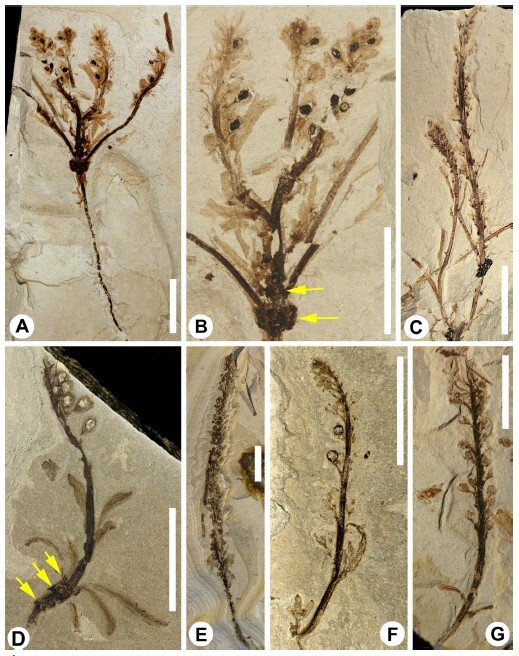
Vegetative and reproductive morphology
of Kohlsia parachutensis gen. et sp. nov.,
an herbaceous angiosperm from the Eocene
Green River Formation of western Colorado, USA
1
Florida Museum of Natural History, Dickinson Hall, 1659 Museum Road, Gainesville, FL 32611-7800, USA
2
University of Minnesota Herbarium, Bell Museum, 2088 Larpenteur Ave. West, University of Minnesota,
St. Paul, MN 55113, USA
3
Department of Earth Science and College of Creative Studies, University of California, Santa Barbara,
Santa Barbara, CA 93106, USA
These authors had equal contribution to this work
Submission date: 2026-02-06
Acceptance date: 2026-06-03
Online publication date: 2026-06-29
Publication date: 2026-06-29
Acta Palaeobotanica 2026; 66(1): 113-124
HIGHLIGHTS
- Piceancea kohlsii represents a potentially extinct lineage of superasterids
- The small stature indicates Piceancea was likely herbaceous
- Its sedimentary context and morphology suggest it was a semiaquatic
KEYWORDS
ABSTRACT
A new angiosperm genus is recognized based on complete plants preserving roots, stems, linear
leaves, inflorescences and infructescences from the late part of the early Eocene of western Colorado, USA. The
plants of Kohlsia parachutensis gen. et sp. nov. measure 5–8 cm in height, and are characterized by an apparent
basal rosette of alternate leaves and a short main axis terminated by a racemose inflorescence with lateral
racemose inflorescences arising alternately. Based on the short stature, heterophyllous leaves, and depositional
context we infer that it was potentially a rooted semiaquatic. The fused hypogynous perianth of five tepals and
single-seeded fruits lead us to consider it likely to be a superasterid, but its ordinal and familial affinities remain
obscure. Kohlsia is a rare example of an herbaceous angiosperm from the Green River flora.
FUNDING
None.
CONFLICT OF INTEREST
The authors
have declared that no competing interests exist.
REFERENCES (24)
1.
Anderson, E.P., Smith, D.M., 2017. The same picture through different lenses: quantifying the effects of two preservation pathways on Green River Formation insects. Paleobiology 43(2), 224–247. https://doi.org/10.1017/pab.20....
2.
Barna, P., Zelagin, D., Šmídová, L., 2023. A new Eocene cockroach species from the Green River Formation of Colorado, USA. Biologia 78(6), 1713–1719. https://doi.org/10.1007/s11756....
3.
Brown, R.W., 1934. The recognizable species of the Green River flora. US Geological Survey Professional Paper 185-C, 44–77. https://doi.org/10.3133/pp185C.
4.
Dayvault, R.D., Codington, L.A., Kohls, D., Hawes, W.D., Ott, P.M., Behnke, D., 1995. Fossil insects and spiders from three locations in the Green River Formation of the Piceance Creek Basin, Colorado. In: Averett, W.R., (ed.), The Green River Formation in Piceance Creek and Eastern Uinta Basins. Grand Junction Geological Society, Grand Junction, Colorado, pp. 97–116.
5.
Grande, L., 2013. The lost world of Fossil Lake. University of Chicago Press, Chicago. https://doi.org/10.7208/chicag....
6.
Hail, W.J. Jr., Smith, M.C., 1997. Geologic map of the southern part of the Piceance Creek Basin, northwestern Colorado. US Geological Survey IMAP 2529. https://doi.org/10.3133/i2529.
7.
Jagniecki, E.A., Lowenstein, T.K., 2015. Evaporites of the Green River Formation, Bridger and Piceance Creek Basins: deposition, diagenesis, paleobrine chemistry, and Eocene atmospheric CO2. In: Smith, M.E., Carroll, A.R. (eds), Stratigraphy and Paleolimnology of the Green River Formation, Western USA. Syntheses in Limnogeology, vol 1. Springer, Dordrecht, pp. 277–312. https://doi.org/10.1007/978-94....
8.
Johnson, K.R., Plumb, C., 1995. Plant fossils from the Green River Formation at Douglas Pass, Colorado, and Bonanza, Utah. In: Averett, W.R. (ed.). The Green River Formation in Piceance Creek and eastern Uinta Basins. Grand Junction Geological Society, Grand Junction, Colorado, pp. 121–130.
9.
Lawton, T.F., 2008. Laramide sedimentary basins. In: Miall, A.D., (ed.), Sedimentary basins of the world, vol. 5. The Sedimentary Basins of the United States and Canada, Science Direct, pp. 429–450. https://doi.org/10.1016/S1874-....
10.
Li, G., Hu, S., Hou, H., Kimura, S., 2019. Heterophylly: phenotypic plasticity of leaf shape in aquatic and amphibious plants. Plants 8(10), 420. https://doi.org/10.3390/plants....
11.
Lott, T.A., Manchester, S.R., Dilcher, D.L., 1998. A unique and complete polemoniaceous plant from the middle Eocene of Utah, USA. Review of Palaeobotany and Palynology 104, 39–49. https://doi.org/10.1016/S0034-....
12.
Lundell, L.L., Surdam, R.C., 1975. Playa-lake deposition: Green River Formation, Piceance Creek Basin, Colorado. Geology 3, 493–497. https://doi.org/10.1130/0091-7....
13.
MacGinitie, H.D., 1969. The Eocene Green River flora of northwestern Colorado and northeastern Utah. University of California Publications in Geological Sciences 83, 1–203.
14.
O’Sullivan, R.B., 1986. Preliminary geologic map of the Anvil Points Quadrangle, Garfield County, Colorado (1:24000). US Geological Survey Miscellaneous Field Studies Map MF-1882.
15.
Perry, M.L., 1995. Preliminary description of a new fossil scorpion from the middle Eocene Green River Formation, Rio Blanco County, Colorado. In: Averett, W.R., (ed.), The Green River Formation in Piceance Creek and eastern Uinta Basins. Grand Junction Geological Society, Grand Junction, Colorado, pp. 131–133.
16.
Pipiringos, G., Johnson, R.C., 1975. Preliminary geologic map of the Buckskin Point Quadrangle, Rio Blanco County, Colorado: U.S. Geological Survey Miscellaneous Field Studies Map 651.
17.
Remy, R.R., 1992, Stratigraphy of the Eocene part of the Green River Formation in the south-central part of the Uinta Basin, Utah: U.S. Geological Survey Bulletin 1787-BB, 1–79.
18.
Roehler, H.W., 1974. Depositional environments of rocks in the Piceance Creek Basin, Colorado. In: Murray, D.K., (ed.), Guidebook to the energy resources of the Piceance Creek Basin, Colorado: Denver, Colorado, Rocky Mountain Association of Geologists, 25th Annual Field Conference, pp. 57–64.
19.
Santiago-Blay, J.A., Soleglad, M.E., Fet, V., 2004. A redescription and family placement of Uintascorpio Perry, 1995 from the Parachute Creek Member of the Green River Formation (Middle Eocene) of Colorado, USA (Scorpiones: Buthidae). Revista Ibérica de Aracnología 10, 7–16.
20.
Smith, M.E., 2007. Stratigraphy, geochronology, and paleogeography of the Green River Formation, Wyoming, Colorado, and Utah [Ph.D. thesis]: Madison, University of Wisconsin, 318 p.
21.
Smith, M.E., Carroll, A.R., Singer, B.S., 2008. Synoptic reconstruction of a major ancient lake system: Eocene Green River Formation, western United States. Geological Society of America Bulletin 120 (1–2), 54–84. https://doi.org/10.1130/B26073....
22.
Thomaz, S.M., 2025. Asexual reproduction of aquatic macrophytes via stem fragments: A review on determinants of plant fragmentation and propagule dispersal. Hydrobiologia. https://doi.org/10.1007/s10750....
23.
Young, R.G., 1995. Stratigraphy of Green River Formation in Piceance Creek Basin, Colorado. In: Averett, W.R., (ed.), The Green River Formation in Piceance Creek and Eastern Uinta Basins. Grand Junction Geological Society, Grand Junction, Colorado, pp. 1–21.
24.
Wilf, P., 2000. Late Paleocene–early Eocene climate changes in southwestern Wyoming: Paleobotanical analysis. Geological Society of America Bulletin 112, 292–307. https://doi.org/10.1130/0016-7....
Share
RELATED ARTICLE
| eISSN: | 2082-0259 |
| ISSN: | 0001-6594 |


We process personal data collected when visiting the website. The function of obtaining information about users and their behavior is carried out by voluntarily entered information in forms and saving cookies in end devices. Data, including cookies, are used to provide services, improve the user experience and to analyze the traffic in accordance with the Privacy policy. Data are also collected and processed by Google Analytics tool (more).
You can change cookies settings in your browser. Restricted use of cookies in the browser configuration may affect some functionalities of the website.
You can change cookies settings in your browser. Restricted use of cookies in the browser configuration may affect some functionalities of the website.