
ORIGINAL ARTICLE
Carpological remains from the Pliocene of
Almenno and the Early Pleistocene of Leffe in the
collections of the Caffi Museum of Bergamo, Italy
1
Earth Sciences Dept., Turin University, via Valperga Caluso 35, 10125 Turin, Italy
2
Museo Civico di Scienze Naturali “E. Caffi”, Piazza Cittadella 10, 24129 Bergamo, Italy
3
University of Milan Bicocca, Dept. of Earth and Environmental Sciences, Piazza della Scienza 1,
20126 Milan, Italy
4
Palaeo-Bavarian-Geological Survey, Daxerstr. 21, D-82140 Olching, Germany
Submission date: 2025-03-19
Acceptance date: 2025-06-02
Online publication date: 2025-12-18
Publication date: 2025-12-18
Acta Palaeobotanica 2025; 65(2): 156-192
HIGHLIGHTS
- Insights on the palaeoflora, palaeovegetation and palaeoclimate of northern Italy
- Museum collection catalogued and available for deeper future studies
- Fruit and seed assemblages provide new information in a poorly studied area
KEYWORDS
ABSTRACT
The Caffi Museum of Bergamo hosts numerous fossil fruits, seeds, cones and fructifications found
in the marine deposits of the Pliocene, close to the village of Almenno, and in the lacustrine deposits of the Early
Pleistocene lignite-bearing basin of the historical locality Leffe. Despite the bias towards larger carpological
objects, the material can be considered very relevant for the study of the history of vegetation development in
Northern Italy during the late Cenozoic, because it originates from independently dated sediments and from an
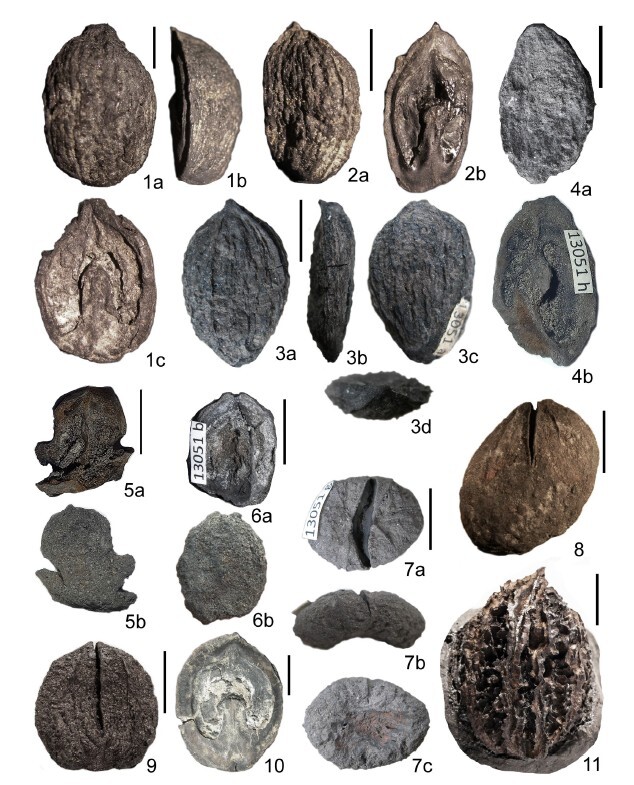
area that is poor in palaeocarpological assemblages. As a result of the palaeocarpological analyses, 8 carpological
taxa have been determined at Almenno, and 21 at Leffe, 18 of which could be identified to a modern genus.
Eventual previous determinations, often preliminary, are revised, but the occurrence of carpological remains of
Carya, Phellodendron and Magnolia is confirmed and well-assessed in the Calabrian. Several fossil-species are
reported for the first time in the studied area and permit a comparison with richer assemblages occurring in
the neighbouring Piemonte region.
FUNDING
No.
CONFLICT OF INTEREST
The authors
have declared that no competing interests exist.
REFERENCES (115)
1.
Artis, E.T., 1825. Antediluvian phytology, illustrated by a collection of the fossil remains of plants peculiar to the coal formations of Great Britain. J. Cumberland, Rodwell and Martin, W. Phillips, Taylor, Hessey and Nichols and Son, London, 24 pp. https://doi.org/10.5962/bhl.ti....
2.
Baldanza, A., Spirito, A., 2010. Dalla classificazione alla musealizzazione: Allestimento di un’esposizione di reperti vegetali fossili presso il “Centro Studi sul Quaternario” (CeSQ) di Sansepolcro. Museologia Scientifica, Nuova Serie 41, 130–136.
3.
Balsamo Crivelli, G., 1840. Nota sul rinoceronte fossile esistente nell’I.R. Gabinetto de’minerali e fossili nel locale di santa Teresa in Milano; Descrizione di alcuni denti di rinoceronte, e d’una nuova specie d’Iuglandite trovati nella lignite di Leffe, e Cenni sovra alcuni altri fossili riscontrati nel calcareo nero sopra Varenna e presso Bellagio. Biblioteca Italiana o sia Giornale di Letterature, Scienze ed Arti 95, 287–292.
4.
Basilici, G., Martinetto, E., Pavia, G., Violanti, D., 1997. Paleoenvironmental evolution in the Pliocene marine-coastal succession of Val Chiusella (Ivrea, NW Italy). Bollettino della Società Paleontologica Italiana 36(1–2), 23–52.
5.
Bertoldi, R., Martinetto, E., 1995. Ricerche paleobotaniche (palinologiche e paleocarpologiche) sulla successione villafranchiana del Rio Ca’ Viettone. Il Quaternario 8(2), 403–422.
6.
Bittrich, V., 1993. Introduction to centrospermae. In: Kubitzki, K., Rohwer, J.G., Bittrich, V. (eds), Flowering Plants. Dicotyledons. The Families and Genera of Vascular Plants, vol 2. Springer, Berlin, Heidelberg, pp. 13–19. https://doi.org/10.1007/978-3-....
7.
Brambilla, G., 1984. I vegetali fossili delle argille grigie plioceniche del T. Tornago (BG) nelle collezioni del Museo Civico “E. Caffi” di Bergamo. Rivista del Museo di Scienze Naturali di Bergamo 8, 3–16.
8.
Brambilla, G., Cantaluppi, G., Lualdi, A., 1983. Panorama generale del Pliocene nel Bergamasco. Rivista del Museo di Scienze Naturali di Bergamo 6, 2–25.
9.
Breda, M., Marchetti, M., 2007. Pleistocene mammal faunas from the Leffe Basin (Bergamo, Northern Italy): revision and new data. Courier-Forschungsinstitut Senckenberg 259, 61–77.
10.
Brongniart, A., 1822. Sur la classification et la distribution des végétaux fossiles en général, et sur ceux des terrains de sediment supérieur en particulier. Chapitre II. Sur quelques végétaux fossiles des terrains de sédiment supérieur. Mémoires du Muséum d’Histoire Naturelle 8, 297–348.
11.
Cavallo, O., Pavia, G., Macagno, M., 1986. Fossili dell’Albese: aspetti geologici e paleontologici delle Langhe e del Roero. Famija albeisa. 217 pp.
12.
Cavallo, P., Martinetto, E., 2001. Flore carpologiche del Pliocene di Castelletto Cervo (Biella). Bollettino del Museo Regionale di Scienze Naturali di Torino 18(2), 277–343.
13.
Cleal, C.J., Thomas, B.A., 2018. Nomenclatural status of the Palaeobotanical “Artificial Taxa” established in Brongniart’s 1822 “Classification” paper. Fossil Imprint 74(1–2), 9–28. https://doi.org/10.2478/if-201....
14.
Confortini, F., Malzanni, M., Mangili, C., Paganoni, A., 2003. Ritrovamento di un Cervidae nei sedimenti del Bacino Pleistocenico di Piànico-Sèllere (Italia Settentrionale). Rivista del Museo Civico di Scienze Naturali “E. Caffi” Bergamo 21 del 2001, 87–94.
15.
Cremaschi, M., Ravazzi, C., 1995. Nuovi dati stratigrafici e geocronologici sul Bacino di Leffe (Prealpi Lombarde – Bergamo). Il Quaternario 8(1), 167–182.
16.
Deng, M., Kvaček, J., Heřmanová, Z., Manchester, S.R., 2024. Comparative nut morphology and biogeographic implications of Carya ventricosa from the Miocene of Europe. International Journal of Plant Sciences 185, 109–128. https://doi.org/10.1086/728185.
17.
Denk, T., Sami, M., Teodoridis, V., Martinetto, E., 2022. The late Early Pleistocene flora of Oriolo, Faenza (Italy): Assembly of the modern forest biome. Fossil Imprint 78(1), 217–262. https://doi.org/10.37520/fi.20....
18.
Emmert-Straubinger, E., 1991. Die Interglazialflora von Pianico (Prov. Bergamo, Italien). In: Kovar-Eder, J. (ed.), Proceedings of the Pan-European Palaeobotanical Conference, Vienna, 19–23 September 1991. Museum of Natural History, Vienna, pp. 15–18.
19.
Fabbricosi, E., 1983. Strobili e semi fossili delle argille plioceniche di Almenno (BG). Sottotesi Sperimentale, Facoltà di Scienze Matematiche Fisiche e Naturali, Università di Pavia, Academic Year 1982–1983, 25 pp.
20.
Ferguson, D.K., 1989. A survey of the Liquidambaroideae (Hamalelidaceae) with a view to elucidating its fossil record. In: Crane, P.R., Blackmore, S. (eds), Evolution, Systematics, and Fossil History of the Hamamelidaceae. Volume 1: Introduction and ‘Lower’ Hamamelidae. Systematics Association Special volume, 40A, pp. 273–8. Clarendon Press, Oxford.
21.
Ferrero, E., Merlino, B., Provera, A., Martinetto, E., 2003. Associazione a molluschi marini e vegetali terrestri del Pliocene di Castellengo (Biella, Italia NW). Rendiconti Società Paleontologica Italiana 2, 87–106.
22.
Field, M.H., 2013. Identification of a population of Ranunculus achenes extracted from Middle Pleistocene sediments exposed at Belhus Park, Essex, UK. Acta Palaeobotanica 53(2), 181–189. https://doi.org/10.2478/acpa-2....
23.
Fischer, T.C., Butzmann, R., 2000. Die neogene Flora von Meleto (Valdarno, Italien). Paläobotanik, Paläoökologie und Paläoklima. Flora Tertiaria Mediterranea 5(6), 1–186.
24.
Geissert, F., Gregor, H.J., Mai, D.H., 1990. Die „Saugbaggerflora“, eine Frucht- und Samenflora aus dem Grenzbereich Miozän-Pliozän von Sessenheim im Elsass (Frankreich). Documenta Naturae 57, 1–208.
25.
Ghiotto, P., 2010. La carpoflora del bacino lacustre villafranchiano di Steggio (Treviso, Prealpi orientali). Bollettino del Museo Regionale di Scienze Naturali 27(1), 3–99.
26.
Girotti, O., Capasso Barbato, L., Esu, D., Gliozzi, E., Kotsakis, A., Martinetto, E., Petronio, C., Sardella, R., Squazzini, E., 2003. The section of Torre Picchio (Terni, Umbria, Central Italy): a Villafranchian site rich in mammals, molluscs, ostracods and plants. Rivista Italiana di Paleontologia e Stratigrafia (Research in Paleontology and Stratigraphy) 109(1), 77–98.
27.
Gregor, H.-J., 1986. Preliminary results of the Plio-Pleistocene flora from Stirone river (Parma, Fidenza). Memorie della Società Geologica Italiana 31, 219–227.
28.
Gregor, H.-J., 1990. Contribution to the Late Neogene and Early Quaternary floral history of the Mediterranean. Review of Palaeobotany and Palynology 62, 309–338. https://doi.org/10.1016/0034-6....
29.
Gregor, H.-J., 1993. Wutzlers Amberbaum – ein neues exotisches Element aus dem Obermiozän von Hambach (Rheinbraun, Koln). Documenta Naturae 80, 1–9.
30.
Günther, T., Gregor, H.J., 1990. Computer-Analyse mitteleuropäischer Frucht- und Samenfloren Europas, Band 2. Documenta Naturae 50(2), 1–159.
31.
Huang, Y.J., Liu, Y.S., Zavada, M., 2014. New fossil fruits of Carya (Juglandaceae) from the latest Miocene to earliest Pliocene in Tennessee, eastern United States. Journal of Systematics and Evolution, 52(4), 508–520. https://doi.org/10.1111/jse.12....
32.
Ickert-Bond, S.M., Pigg, K.B., Wen, J., 2005. Comparative infructescence morphology in Liquidambar (Altingiaceae) and its evolutionary significance. American Journal of Botany 92, 1234–1255. https://doi.org/10.3732/ajb.92....
33.
IFPNI, 2014 onwards. The International Fossil Plant Names Index. Global registry of scientific names of fossil organisms covered by the International Code of Nomenclature for Algae, Fungi, and Plants (formerly International Code of Botanical Nomenclature) and International Code of Zoological Nomenclature. Available from: http://ifpni.org/. Accessed 19 May 2025.
34.
Irace, A., Monegato, G., Tema, E., Martinetto, E., Gianolla, D., Vassio, E., Bellino, L., Violanti, D., 2017. Unconformity-bounded stratigraphy in the Plio-Pleistocene continental record: new insights from the Alessandria Basin (NW Italy). Geological Journal 52, 177–206. https://doi.org/10.1002/gj.274....
35.
Kowalski, R., Tietz, O., Worobiec, E., Worobiec, G., 2024. New floras from the Tetta Clay Pit, Upper Lusatia, late Oligocene–Early Miocene, Germany. Annales Societatis Geologorum Poloniae 94(1), 19–59. https://doi.org/10.14241/asgp.....
36.
Kunzmann, L., 2014. On the fossil history of Pseudotsuga Carr. (Pinaceae) in Europe. Palaeobiodiversity & Palaeoenvironment 94(2), 393–409. https://doi.org/10.1007/s12549....
37.
Kunzmann, L., Mai, D.H., 2005. Die Koniferen der Mastixioideen-Flora von Wiesa bei Kamenz (Sachsen, Miozän) unter besonderer Berücksichtigung der Nadelblätter. Palaeontographica, Abt. B 272, 67–135. https://doi.org/10.1127/palb/2....
38.
Kvaček, Z., Teodoridis, V., Mazouch, P., Roiron, P., 2014. Fossil seed cones of Pinus L. (sect. Pinus, subsect. Pinaster Loudon, Sula group) from the late Neogene and early Pleistocene of Europe. Palaeontographica, Abt. B 291, 131–164. https://doi.org/10.1127/palb/2....
39.
Ma, J., Cao, W., Liu, Q., Yu, M., Han, L., 2006. A revision of Phellodendron (Rutaceae). Edinburgh Journal of Botany 63(2–3), 131–151. https://doi.org/10.1017/S09604....
40.
Macaluso, L., Martinetto, E., Vigna, B., Bertini, A., Cilia, A., Teodoris, V., Kvaček, Z., 2018. Palaeofloral and stratigraphic context of a new fossil forest from the Pliocene of NW Italy. Review of Palaeobotany and Palynology 248, 15–33. https://doi.org/10.1016/j.revp....
41.
Magri, D., Palombo, M.R., 2013. Early to Middle Pleistocene dynamics of plant and mammal communities in South West Europe. Quaternary International 288, 63–72. https://doi.org/10.1016/j.quai....
42.
Mai, D.H., 1975. Beiträge zur Bestimmung und Nomenklatur fossiler Magnolien. Feddes Repertorium 86(9–10), 559–578. https://doi.org/10.1002/fedr.1....
43.
Mai, D.H., 1981. Der Formenkreis der Vietnam-Nuss [Carya poilanei (Chev.) Leroy] in Europa. Feddes Repertorium 92(5–6), 339–385. https://doi.org/10.1002/fedr.1....
44.
Mai, D.H., 1986. Über Typen und Originale tertiärer Arten von Pinus L. (Pinaceae) in mitteleuropäischen Sammlungen – Ein Beitrag zur Geschichte der Gattung in Europa. Feddes Repertorium 97(9–10), 571–605. https://doi.org/10.1002/j.1522....
45.
Mai, D.H., 1994. Fossile Koniferenreste in der meridionalen Zone Europas. Feddes Repertorium 105, 207–227. https://doi.org/10.1002/fedr.1....
46.
Mai, D.H., 1997. Die oberoligozänen Floren an Nordrand der Sachsischen Lausitz. Palaeontographica, Abt. B 244, 1–124.
47.
Mai, D.H., 1999. Die untermiozänen Floren aus der Spremberger Folge und dem. 2. Flözhorizont in der Lausitz. Teil II, Polycarpicae und Apetale. Palaeontographica, Abt. B 251(1–3), 1–76. https://doi.org/10.1127/palb/2....
48.
Mai, D.H., Velitzelos, E., 1992. Über fossile Pinaceen-Reste im Jungtertiär von Griechenland. Feddes Repertorium 103(1–2), 1–18. https://doi.org/10.1002/fedr.1....
49.
Mai, D.H.,Velitzelos, E., 1997. Paläokarpologische Beiträge zur jungtertiären Flora von Vegora (Nordgriechenland). Feddes Repertorium 108(7–8), 507–526. https://doi.org/10.1002/fedr.1....
50.
Mai, D.H., Walther, H., 1988. Die pliozänen Floren von Thüringen, Deutsche Demokratische Republik. Quartärpaläontologie 7, 55–297. https://doi.org/10.1515/978311....
51.
Mai, D.H., Wähnert, V., 2000. On the problems of the Pliocene floras in Lusatia and Lower Silesia. Acta Palaeobotanica 40(2), 165–205.
52.
Martinetto, E., 1994a. Analisi paleocarpologica dei depositi continentali pliocenici della Stura di Lanzo. Bollettino del Museo Regionale di Scienze Naturali di Torino 12(1), 137–172.
53.
Martinetto, E., 1994b. Paleocarpology and the “in situ” ancient plant communities of a few Italian Pliocene fossil forests. In: Matteucci, R., Carboni, M.G., Pignatti, J.S. (eds), Studies on ecology and paleoecology of benthic communities. Bollettino della Società Paleontologica Italiana, Spec. Vol. 2, 189–196.
54.
Martinetto, E., 1995. Significato cronologico e paleoambientale dei macrofossili vegetali nell’inquadramento stratigrafico del “Villafranchiano” di alcuni settori del Piemonte (Italia NW). Ph.D. Thesis, University of Turin, Italy, 149 pp.
55.
Martinetto, E., 1998. East Asian elements in the Plio-Pleistocene floras of Italy. In: Zhang, A., Sugong, W. (eds), Proc. Int. Symp. Floristic charact. Diversity East Asian Plants. Berlin, Springer Verlag, pp. 71–87.
56.
Martinetto, E., 1999. Chronological framing of Pliocene to Early Pleistocene plant macrofossil assemblages from northern Italy. Acta Palaeobotanica, Supplement 2, 503–511.
57.
Martinetto, E., 2001a. The role of central Italy as a centre of refuge for thermophilous plants in the late Cenozoic. Acta Palaeobotanica 41(2), 299–319.
58.
Martinetto, E., 2001b. Studies on some exotic elements of the Pliocene floras of Italy. Palaeontographica, Abt. B 259, 149–166. https://doi.org/10.1127/palb/2....
59.
Martinetto, E. (ed.), 2001c. Pliocene plants, environment and climate of northwestern Italy. Flora Terziaria Mediterranea 4, 1–120.
60.
Martinetto, E., 2003. Leaves of terrestrial plants from the shallow marine and transitional Pliocene deposits of Asti (Piedmont, NW Italy). Bollettino della Società Paleontologica Italiana 42(1–2), 75–114.
61.
Martinetto, E., 2009. Palaeoenvironmental signifcance of plant macrofossils from the Piànico Formation, Middle Pleistocene of Lombardy, North Italy. Quaternary International 204, 20–30. https://doi.org/10.1016/j.quai....
62.
Martinetto, E., 2015. Monographing the Pliocene and Early Pleistocene carpofloras of Italy: methodological challenges and current progress. Palaeontographica, Abt. B 293, 57–99. https://doi.org/10.1127/palb/2....
63.
Martinetto, E., Caleca, R., 2024. Overview of Pliocene plant macrofossil localities of the Piemonte region (NW Italy) with a partial analysis of palaeobotanical and geoconservation interest. Acta Palaeobotanica 64(1), 75–108. https://doi.org/10.35535/acpa-....
64.
Martinetto, E., Festa, C., 2013. Frutti e semi fossili del Biellese. Rivista Biellese 2013, 169–188.
65.
Martinetto, E., Mai, D.H., 1996. Macrofossili vegetali. In: Carraro, F. (ed.), Revisione del Villafranchiano nell’area-tipo di Villafranca d’Asti. Il Quaternario 9, 73–79.
66.
Martinetto, E., Ravazzi, C., 1997. Plant biochronology of the Valle della Fornace succession (Varese) based on the Plio-Pleistocene record in northern Italy. Geologia Insubrica 2(2), 81–98.
67.
Martinetto, E., Vassio, E., 2010. Reconstructing “Plant Community Scenarios” by means of palaeocarpological data from the CENOFITA database, with an example from the Ca’ Viettone site (Pliocene, Northern Italy). Quaternary International 225, 25–36. https://doi.org/10.1016/j.quai....
68.
Martinetto, E., Monegato, G., Vassio, E., 2012. An Early Pleistocene Plant Assemblage with East European Affinity in the Venetian-Friulian Basin (NE Italy). Alpine and Mediterranean Quaternary 25(2), 91–104.
69.
Martinetto, E., Bertini, A., Basilici, G., Baldanza, A., Bizzarri, R., Cherin, M., Gentili, S., Pontini, M.R., 2014. The plant record of the Dunarobba and Pietrafitta sites in the Plio–Pleistocene palaeoenvironmental context of central Italy. Alpine and Mediterranean Quaternary 27(1), 29–72.
70.
Martinetto, E., Monegato, G., Irace, A., Vaiani, S.C., Vassio, E., 2015a. Pliocene and Early Pleistocene carpological records of terrestrial plants from the southern border of the Po Plain (northern Italy). Review of Palaeobotany and Palynology 218, 148–166. https://doi.org/10.1016/j.revp....
71.
Martinetto, E., Ravazzi, C., Roghi, G., Teruzzi, G., Ham, R.V.D., Zorzin, R., 2015b. Neotypification of the name Juglandites bergomensis, basionym of the fossil-species Juglans bergomensis (Juglans sect. Cardiocaryon, Juglandaceae). Phytotaxa 234(3), 280–286. https://doi.org/10.11646/phyto....
72.
Martinetto, E., Momohara, A., Bizzarri, R., Baldanza, A., Delfino, M., Esu, D., Sardella, R., 2017. Late persistence and deterministic extinction of humid thermophilous plant taxa of East Asian affinity (HUTEA) in southern Europe. Palaeogeography, Palaeoclimatology, Palaeoecology 467, 211–231. https://doi.org/10.1016/j.pala....
73.
Martinetto, E., Tema, E., Irace, A., Violanti, D., Ciuto, M., Zanella, E., 2018. High-diversity European palaeoflora favoured by early Pliocene warmth: New chronological constraints from the Ca’ Viettone section, NW Italy. Palaeogeography, Palaeoclimatology, Palaeoecology 496(3), 248–267. https://doi.org/10.1016/j.pala....
74.
Martinetto, E., Bertini, A., Mantzouka, D., Natalicchio, M., Niccolini, G., Kovar-Eder, J., 2022. Remains of a subtropical humid forest in a Messinian evaporite-bearing succession at Govone, northwestern Italy. Fossil Imprint, 78, 157–188. https://doi.org/10.37520/fi.20....
75.
Martinetto, E., De Franceschi, D., Del Rio, C., Manchester, S.R., 2025. Carya nux-taurinensis comb. nov., a fossil-species incorporating Carya globosa (Juglandaceae). Taxon. https://doi.org/10.1002/tax.70... [published online].
76.
Massalongo, A., 1852a. Nota sopra due frutti fossili del bacino lignitico di Leffe nel Bergamasco. Nuovi Annali delle Scienze Naturali, serie 3, 6, 253–258.
77.
Massalongo, A., 1852b. Breve rivista dei frutti fossili di Noce fino ad ora conosciuti e descrizione di alcune nuove specie. Nuovi Annali delle Scienze Naturali, serie 3, 6, 457–464.
78.
Massalongo, A., 1856. V. Sopra due frutti fossili di Castagno del bacino lignitico di Leffe. In: Massalongo, A. (ed.), Studii Paleontologici, Tipografia G. Antonelli, Verona, pp. 32–35.
79.
Meschinelli, L., Squinabol, S., 1892. Flora tertiaria Italica, auctoribus A. Meschinelli, X. Squinabol. Patavii, Sumptibus auctorum, typis seminarii. https://doi.org/10.5962/bhl.ti....
80.
Muttoni, G., Ravazzi, C., Breda, M., Pini, R., Laj, C., Kissel, C., Mazaud, A., Garzanti, E., 2007. Magnetostratigraphy of the Leffe lacustrine succession (Southern Alps, Italy): evidence for an intensification of glacial activity in the Alps at Marine Isotope Stage 22 (0.87 Ma). Quaternary Research 67, 161–173. https://doi.org/10.1016/j.yqre....
81.
Pandolfi, L., Spadi, M., Martinetto, E., Kotsakis, T., Esu, D., 2017. New data on the Lower Pleistocene (Gelasian) lignite beds of Castel San Pietro (Rieti, central Italy. Rivista Italiana di Paleontologia e Stratigrafia (Research in Paleontology and Stratigraphy) 123(2), 335–346.
82.
Pavia, G., 1970. Resti di Anancus arvernensis e flora ad affinità plioceniche nel Villafranchiano inferiore della cava Arboschio (Villafranca d’Asti). Pacini. Memorie della Società Geologica Italiana 9, 157–176.
83.
Pigg, K.B., Ickert-Bond, S.M., Wen, J., 2004. Anatomically preserved Liquidambar (Altingiaceae) from the middle Miocene of Yakima Canyon, Washington state, USA, and its biogeographic implications. American Journal of Botany 91(3), 499–509. https://doi.org/10.3732/ajb.91....
84.
Pigott, D., 2012. Lime-trees and basswoods: a biological monograph of the genus Tilia. Cambridge University Press. https://doi.org/10.1017/CBO978....
85.
Ravazzi, C., 1995. Paleobotany of the biogenic unit of the Leffe Formation (Early Pleistocene, N-Italy): brief report on the status of the art. Il Quaternario-Italian Journal of Quaternary Sciences 8(2), 435–442.
86.
Ravazzi, C., 2003. Gli antichi bacini lacustri e i fossili di Leffe, Ranica e Piànico-Sèllere (Prealpi Lombarde). Quaderni di Geodinamica Alpina e Quaternaria (numero speciale), Quaderni della Comunità Montana Valle Seriana 2, 1–176.
87.
Ravazzi, C., Moscariello, A., 1998. Sedimentation, palaeoenvironmental evolution and time duration of earliest Pleistocene climatic cycles in the 24–56 m FM-core interval (Leffe Basin, northern Italy). In: Kolfschoten, Th. Van, Gibbard, P. (eds) Proceedings of the INQUA-SEQS Symposium ‘The dawn of the Quaternary’. Mededelingen Nederlands Instituut voor Toegepaste Geowetenschappen 60, 467–490.
88.
Ravazzi, C., Rossignol-Strick, M., 1995. Vegetation change in a climatic cycle of early Pleistocene age in the Leffe Basin (Northern Italy). Palaeogeography, Palaeoclimatology, Palaeoecology 117, 105–122. https://doi.org/10.1016/0031-0....
89.
Ravazzi C., Van der Burgh, J., 1994. Coniferous woods in the Early Pleistocene brown coals of the Leffe Basin (Lombardy, Italy). Ecological and biostratigraphical inferences. Rivista Italiana di Paleontologia e Stratigrafia 100(4), 597–620.
90.
Ravazzi, C., Pini, R., Breda, M., Martinetto, E., Muttoni, G., Chiesa, S., Confortini, F., Egli, R., 2005. The lacustrine deposits of Fornaci di Ranica (late Early Pleistocene, Italian Pre-Alps): stratigraphy, palaeoenvironment and geological evolution. Quaternary International 131, 35–58. https://doi.org/10.1016/j.quai....
91.
Ravazzi, C., Pini, R., Breda, M., 2009a. Reconstructing the palaeoenvironments of the early Pleistocene mammal faunas from the pollen preserved on fossil bones. Quaternary Science Reviews 28, 2940–2954. https://doi.org/10.1016/j.quas....
92.
Ravazzi, C., Breda, M., Perego, R., Pini, R., 2009b. 40 animali e piante dell’antico lago di Leffe. Comunità Montana Valle Seriana e CNR IDPA Bergamo, printed depliant also available online: https://www.parco-laghifossili.... Accessed 25 Nov. 2024.
93.
Reid, C., Reid, E.M., 1907. The flora of Tegelen-sur Meuse, near Venloo, in the province Limburg. Verslagen Koninklijke Akademie Wetenschappen, sect. 2 13(6), 1–26.
94.
Reid, C., Reid, E.M., 1915. The Pliocene floras of the Dutch-Prussian border. Mededeelingen van de Rijksopsporing van Delfstoffen 6, 1–178. https://doi.org/10.5962/bhl.ti....
95.
Reid, E.M., 1920. Recherches sur quelques graines pliocènes du Pont-de-Gail (Cantal). Bulletin de la Société Géologique de France, série IV, 20, 48–87.
96.
Sigovini, M., Keppel, E., Tagliapietra, D., 2016. Open Nomenclature in the biodiversity era. Methods in Ecology and Evolution 7(10), 1217–1225. https://doi.org/10.1111/2041-2....
97.
Sordelli, F., 1874. Descrizione di alcuni avanzi vegetali delle argille plioceniche lombarde, coll’aggiunta di un elenco delle piante fossili finora conosciute in Lombardia. Atti della Società Italiana di Scienze Naturali 16(3), 350–429.
98.
Sordelli, F., 1896. Studi sulla vegetazione di Lombardia durante i tempi geologici. Tipografia L. F. Cogliati, Milano, 300 pp. https://doi.org/10.5962/bhl.ti....
99.
Spitzlberger, G., 1984. Eine urtümliche Lindenart der Tertiärzeit (Tilia atavia nov. spec.) von Goldern bei Landshut (Niederbayern). Naturwissenschaftliche Zeitschrift für Niederbayern 30, 133–171.
100.
Szafer, W., 1954. Plioceńska flora okolic Czorsztyna i jej stosunek do Plejstocenu. Instytut Geologiczny Prace 11, 1–238.
101.
Tiffney, B.H., 1980. Fruits and seeds of the Brandon Lignite, V. Rutaceae. Journal of the Arnold Arboretum 61(1), 1–40. https://doi.org/10.5962/p.1858....
102.
Tongiorgi, E., 1936. Ricerche sulla vegetazione dell’Etruria marittima. V: Documenti per la storia della vegetazione della Toscana e del Lazio. Nuovo Giornale Botanico Italiano, Nuova Serie 43(4), 785–830. https://doi.org/10.1080/112635....
103.
Turland, N.J., Wiersema, J.H., Barrie, F.R., Greuter, W., Hawksworth, D.L., Herendeen, P.S., Knapp, S., Kusber, W.-H., Li, D.-Z., Marhold, K., May, T.W., McNeill, J., Monro, A.M., Prado, J., Price, M.J. Smith, G.F. (eds), 2018. International Code of Nomenclature for algae, fungi, and plants (Shenzhen Code) adopted by the Nineteenth International Botanical Congress Shenzhen, China, July 2017. Regnum Vegetabile 159. Glashütten: Koeltz Botanical Books. https://doi.org/10.12705/Code.....
104.
Ucchesu, M., Martinetto, E., Sarigu, M., Orrù, M., Bornancin, M., Bacchetta, G., 2024. Morphological characterization of fossil Vitis L. seeds from the Gelasian of Italy by seed image analysis. Plants 13(10), 1417. https://doi.org/10.3390/plants....
105.
Van der Burgh, J., 1978. The Pliocene flora of Fortuna-Garsdorf I. Fruits and seeds of angiosperms. Review of Palaeobotany and Palynology 26, 173–211. https://doi.org/10.1016/0034-6....
106.
Van der Ham, R.W., 2015. On the history of the butternuts (Juglans section Cardiocaryon, Juglandaceae). Palaeontographica Abt. B 293, 125–147. https://doi.org/10.1127/palb/2....
107.
Vassio, E., 2012. Palaeovegetation reconstructions and palaeoclimatic interpretations of Quaternary carpological assemblages with an actuopalaeobotanical approach. PhD Thesis, University of Turin, 281 pp.
108.
Velichkevich, F.Y., Zastawniak, E., 2003. The Pliocene flora of Kholmech, south-eastern Belarus and its correlation with other Pliocene floras of Europe. Acta Palaeobotanica 43(2), 137–259.
109.
Wang, Q., 2011. Proposal to conserve the name Carpolithus with that spelling (fossil Spermatopsida). Taxon 60, 241–242. https://doi.org/10.1002/tax.60....
110.
Weber, C.A., 1898. Ueber eine omorikaartige Fichte aus einer dem älteren Quartäre Sachsens angehärenden Moorbildung. Engler’s Botanische Jahrbücher 24, 510–540.
111.
Winterscheid, H., Gossmann, R., 2017. Validation of Cathaya vanderburghii (Pinaceae) from European Neogene. Phytotaxa 302, 188–192. https://doi.org/10.11646/phyto....
112.
Xu, X.-H., Zhang, X., Yang, L.-Y., 2022. Cathaya vanderburghii, a misnomer for European Neogene fossil cones. Taxon 71, 1107–1111. https://doi.org/10.1002/tax.12....
113.
Zablocki, J., 1930. Tertiär Flora des Salzlagers von Wieliczka. II. Acta Societatis Botanicorum Poloniae 7, 139–156.
114.
Zhang, W.-P., Bai, W.-N., Zhang, D.-Y., 2022. The rediscovery of Carya poilanei (Juglandaceae) after 63 years reveals a new record from China. PhytoKeys 188, 73–82. https://doi.org/10.3897/phytok....
115.
Zidianakis, G., Iliopoulos, G., Zelilidis, A., Kovar-Eder, J., 2020. Three (middle to) late Miocene plant macroremain assemblages (Pitsidia, Kassanoi and Metochia) from the Messara-Gavdos region, southern Crete. Acta Palaeobotanica 60(2), 333–437. https://doi.org/10.35535/acpa-....
CITATIONS (1):
1.
New insights into the chronostratigraphic significance of fossil plants in Pleistocene continental deposits: The Upper Cervo River section (NW Italy)
Edoardo Martinetto, Michela Bornancin, Evdokia Tema
Quaternary International
Edoardo Martinetto, Michela Bornancin, Evdokia Tema
Quaternary International
Share
RELATED ARTICLE
| eISSN: | 2082-0259 |
| ISSN: | 0001-6594 |


We process personal data collected when visiting the website. The function of obtaining information about users and their behavior is carried out by voluntarily entered information in forms and saving cookies in end devices. Data, including cookies, are used to provide services, improve the user experience and to analyze the traffic in accordance with the Privacy policy. Data are also collected and processed by Google Analytics tool (more).
You can change cookies settings in your browser. Restricted use of cookies in the browser configuration may affect some functionalities of the website.
You can change cookies settings in your browser. Restricted use of cookies in the browser configuration may affect some functionalities of the website.