
ORIGINAL ARTICLE
Laurus macrocarpa Lesquereux from
the mid-Cretaceous (Cenomanian) Dakota
Formation, USA, is a chlamydospermous seed,
not an angiosperm fruit
1
Florida Museum of Natural History, Dickinson Hall,1659 Museum Road, Gainesville, FL 32611-7800, USA
2
Oak Spring Garden Foundation, 1776 Loughborough Lane, Upperville, VA 20184, USA
3
Yale School of the Environment, 195 Prospect Street, Yale University, New Haven, CT 06511-2387, USA
Submission date: 2025-12-11
Acceptance date: 2026-04-13
Online publication date: 2026-06-29
Publication date: 2026-06-29
Acta Palaeobotanica 2026; 66(1): 51-66
HIGHLIGHTS
- Disseminules previously treated as angiosperm fruits are shown to be gymnosperm seeds
- The seeds are large compared to previously recognized Cretaceous gnetalean seeds
- Micro-CT scanning revealed new features in fossil seeds collected about 150 years ago
KEYWORDS
ABSTRACT
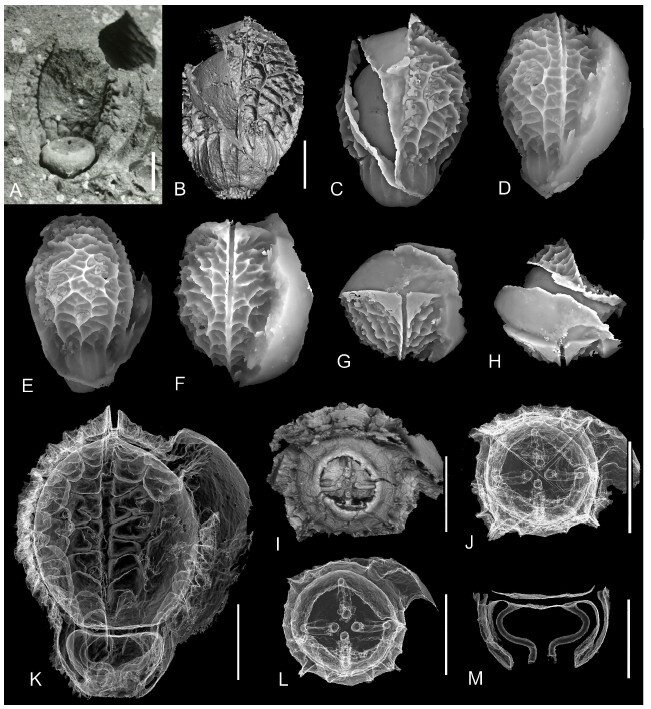
The fossil seed, Decaturospermum macrocarpum (Lesquereux) gen. nov. et comb. nov., is described
based on specimens of latest Albian to mid-Cenomanian age (mid-Cretaceous) from the Dakota Formation of
Nebraska, and Kansas, USA, which were previously named Laurus macrocarpa Lesquereux; and from the Woodbine
Formation of Texas, USA, which were previously named Laurocarpum tetragonale MacNeal. All specimens
are molds and casts lacking cellular details, but light microscopy and micro-CT scanning reveal key structural
features. Combined information from eight specimens indicates that D. macrocarpum is a seed with an outer covering
comprised of four valves. The four valves are reflected in the cast of the seed cavity, which has a quadrangular
transverse section with four rounded edges. Each valve has a smooth outer surface covering a decay-susceptible
outer layer that was replaced by sediment early during fossilization. Sediment filling the space left by the decaysusceptible
outer layer preserves an impression of a distinctive dendritic reticulate system of longitudinal and
transverse ribs on its inner surface, which reflects the outer surface of a decay-resistant inner layer, now seen
only as a cavity. The inner surface of the decay-resistant inner layer is smooth, as is the outer surface of the cast
filling the seed cavity. Below the seed cavity a downward extension of the decay-resistant layer forms a prominent
swollen-cylindrical flange around the seed base. Decay-susceptible tissues inside the swollen flange are replaced by
sediment but preserve the distinctive sinuous course of four vascular bundles. The position of each bundle suggests
that it entered a valve in a near median position. Comparison of Decaturospermum macrocarpum with other seeds
of Cretaceous age indicates that the two-layered, four-valved outer covering is the envelope of a chlamydospermous
seed, which was most likely produced by plants closely related to extant Gnetales.
FUNDING
None.
CONFLICT OF INTEREST
The authors
have declared that no competing interests exist.
REFERENCES (66)
1.
Andrews, H.N., 1980. The fossil hunters. In search of ancient plants. Cornell University Press, Ithaca, 421 pp.
2.
Austen, P.A., Batten, D.J., 2011. 32. Plant megafossils. In: Batten, D.J. (ed.), English Wealden Fossils. Palaeontological Association Field Guide to Fossils 14. Palaeontological Association (London), pp. 596–642.
3.
Barclay, R.S., Rioux, M., Meyer, L.B., Bowring, S.A., Johnson, K.R., Miller, I.M., 2015. High precision U-Pb zircon geochronology for Cenomanian Dakota Formation floras in Utah. Cretaceous Research 52, 213–237. https://doi.org/10.1016/j.cret....
4.
Basinger, J.F., Dilcher, D.L., 1984. Ancient bisexual flowers. Science 224(4648), 511–513. https://doi.org/10.1126/scienc....
5.
Berry, E.W., 1912. Contributions to the Mesozoic flora of the Atlantic coastal plain, VIII; Texas. Bulletin of the Torrey Botanical Club 39, 387–406. https://doi.org/10.2307/247930....
6.
Berry, E.W., 1917. Contributions to the Mesozoic flora of the Atlantic coastal plain, XII; Arkansas. Bulletin of the Torrey Botanical Club 44, 167–190. https://doi.org/10.2307/247952....
7.
Berry, E.W., 1922. The flora of the Woodbine Sand at Arthur’s Bluff, Texas. United States Geological Survey, Professional Paper 129-G, 153–181. https://doi.org/10.3133/pp129G.
8.
Berry, E.W., 1939. Fossil plants from the Cretaceous of Minnesota. Journal of the Washington Academy of Sciences 29, 331–336.
9.
Brenner, G., 1963. The spores and pollen of the Potomac Group of Maryland. Bulletin of the Maryland Department of Geology, Mines and Water Resources 22, 1–215.
10.
Brenner, R.L., Ludvigson, G.A., Witzke, B.J., Zawistoski, A.N., Kvale, E.P., Ravn, R.L., Joeckel, R.M., 2000. Late Albian Kiowa–Skull Creek marine transgression, lower Dakota Formation, eastern margin of Western Interior seaway, U.S.A. Journal of Sedimentary Research 70, 868–878. https://doi.org/10.1306/2dc409....
11.
Cignoni, P., Callieri, M., Corsini, M., Dellepiane, M. Ganovelli, F., Ranzuglia, G., 2008. MeshLab: an open-source mesh processing tool. In: Scarano, V., De Chiara, R., Erra, U. (eds), Sixth Eurographics Italian Chapter Conference, Geneva, July 2–4. Aire-la-Ville, Switzerland. Eurographics Association, pp. 129–136.
12.
Crane, P.R., Dilcher, D.L., 1984. Lesqueria: an early angiosperm fruiting axis from the mid-Cretaceous. Annals of the Missouri Botanical Garden 71, 384–402. https://doi.org/10.2307/239903....
13.
Crane, P.R., Upchurch, G.R., 1987. Drewria potomacensis gen. et sp. nov., an Early Cretaceous member of Gnetales from the Potomac Group of Virginia. American Journal of Botany 74(11), 1722–1736. https://doi.org/10.1002/j.1537....
14.
Dilcher, D.L., 1979. Early angiosperm reproduction: an introductory report. Review of Palaeobotany and Palynology 27, 291–328. https://doi.org/10.1016/0034-6....
15.
Dilcher, D.L., Crane, P.R., 1984. Archaeanthus: an early angiosperm from the Cenomanian of the western interior of North America. Annals of the Missouri Botanical Garden 71, 351–383. https://doi.org/10.2307/239903....
16.
Dilcher, D.L., Kovach, W.L., 1986. Early angiosperm reproduction: Caloda delevoryana gen. et sp. nov., a new fructification from the Dakota Formation (Cenomanian) of Kansas. American Journal of Botany 73, 1230–1237. https://doi.org/10.1002/j.1537....
17.
Doyle, J.A., 1969. Cretaceous angiosperm pollen of the Atlantic coastal plain and its evolutionary significance. Journal of the Arnold Arboretum 50, 1–35. https://doi.org/10.5962/bhl.pa....
18.
Doyle, J.A., 1978. Origin of angiosperms. Annual Review of Ecology and Systematics 9, 365–392. https://doi.org/10.1146/annure....
19.
Doyle, J.A., 2012. Molecular and fossil evidence on the origin of angiosperms. Annual Review of Earth and Planetary Sciences 40, 301–326. https://doi.org/10.1146/annure....
20.
Doyle, J.A., Hickey, L.J., 1976. Pollen and leaves from the mid-Cretaceous Potomac Group and their bearing on early angiosperm evolution. In: Beck, C.B. (ed.), Origin and early evolution of angiosperms. Columbia University Press, New York.
21.
Doyle, J.A., Robbins, E.I., 1977. Angiosperm pollen zonation of the continental Cretaceous of the Atlantic coastal plain and its application to deep wells in the Salisbury embayment. Palynology 1, 43–78. https://doi.org/10.1080/019161....
22.
Friis, E.M., Crane, P.R., Pedersen, K.R., Bengtson, S., Donoghue, P.C.J., Grimm, G.W., Stampanoni, M., 2007. Phase-contrast X-ray microtomography links Cretaceous seeds with Gnetales and Bennettitales. Nature 450, 549–552. https://doi.org/10.1038/nature....
23.
Friis, E.M., Pedersen, K.R., Crane, P.R., 2009. Early Cretaceous mesofossils from Portugal and eastern North America related to the Bennettitales-Erdtmanithecales-Gnetales group. American Journal of Botany 96, 252–283. https://doi.org/10.3732/ajb.08....
24.
Friis, E.M., Crane, P.R., Pedersen, K.R., 2011. Early flowers and angiosperm evolution. Cambridge University Press, Cambridge. https://doi.org/10.1017/CBO978....
25.
Friis, E.M., Crane, P.R., Pedersen, K.R., 2013. New diversity among chlamydospermous seeds from the Early Cretaceous of Portugal and North America. International Journal of Plant Sciences 174(3), 530–558. https://doi.org/10.1086/668250.
26.
Friis, E.M., Crane, P.R., Pedersen, K.R., 2014. Welwitschioid diversity in the Early Cretaceous: Evidence from fossil seeds with pollen from Portugal and eastern North America. Grana 53, 175–176. https://doi.org/10.1080/001731....
27.
Friis, E.M., Crane, P.R., Pedersen, K.R., 2019. Chlamydospermous seeds document the diversity and abundance of extinct gnetalean relatives in Early Cretaceous vegetation. International Journal of Plant Sciences 180(7), 643–666. https://doi.org/10.1086/704356.
28.
Gress, E.M., 1922. An annotated list of fossil plants of the Dakota Formation (Cretaceous) in the collections of the Carnegie Museum, including descriptions of three new species. Annals of the Carnegie Museum 13, 274–329. https://doi.org/10.5962/p.3309....
29.
Gröcke, D.R., Ludvigson, G.A., Witzke, B.L., Robinson, S.A., Joeckel, R.M., Ufnar, D.F., Ravn, R.L., 2006. Recognizing the Albian-Cenomanian (OAE1d) sequence boundary using plant carbon isotopes: Dakota Formation, Western Interior Basin, USA. Geology 34, 193–196. https://doi.org/10.1130/G21998....
30.
Hickey, L.J., Doyle, J.A., 1977. Early Cretaceous fossil evidence for angiosperm evolution. Botanical Review 43, 3–104. https://doi.org/10.1007/BF0286....
31.
Hollick, A., 1903. A fossil petal and a fossil fruit from the Cretaceous (Dakota Group) of Kansas. Bulletin of the Torrey Botanical Club 30, 102–105. https://doi.org/10.2307/247888....
32.
Knowlton, F.H., 1901. Reports by Professor F. H. Knowlton on fossil plants collected by T. Wayland Vaughan in Lamar County; by G. H. Ragsdale in Cooke County; by T. V. Munson in Rhamney Hill, Denison, Texas. In: Hill, R.T. (ed.), United States Geological Survey, 21st Annual Report, 1899–1900, pt. 7, p. 314–318, pl. 39.
33.
Krassilov, V.A., 1986. New floral structure from the Lower Cretaceous of Lake Baikal area. Review of Palaeobotany and Palynology 47, 9–16. https://doi.org/10.1016/0034-6....
34.
Lesquereux, L., 1868. On some Cretaceous fossil plants from Nebraska. American Journal of Science and Arts. Second Series 46, 91–105.
35.
Lesquereux, L., 1874. Contributions to the fossil flora of the Western Territories. Part I. The Cretaceous Flora. In: Hayden, F.V. (ed.), Report of the United States Geological Survey of the Territories, Washington: Government Printing Office 6, pp. 1–136.
36.
Lesquereux, L., 1883. Contributions to the fossil flora of the Western Territories. Part III. The Cretaceous and Tertiary floras. United States Geological Survey of the Territories 8, 2–108.
37.
Lesquereux, L., 1891. Flora of the Dakota Group: a posthumous work. Monographs of the US Geological Survey 17, 1–400. https://doi.org/10.5962/bhl.ti....
38.
Ludvigson, G.A., Witzke, B.J., Joeckel, R.M., Ravn, R. L., Phillips, P.L., González, L.A., Brenner, R.L., 2010. New insights on the sequence stratigraphic architecture of the Dakota Formation in Kansas-Nebraska-Iowa from a decade of sponsored research activity. Current Research in Earth Sciences, Bulletin 258(2), 1–34. https://doi.org/10.17161/kgsbu....
39.
MacNeal, D.L., 1958. The flora of the Upper Cretaceous Woodbine Sand in Denton County, Texas. Monographs of the Academy of Natural Sciences, Philadelphia 10, 1–152.
40.
Manchester, S.R., Dilcher, D.L., Judd, W.S., Corder, B., Basinger, J.F., 2018. Early eudicot flower and fruit: Dakotanthus gen. nov. from the Cretaceous Dakota Formation of Kansas and Nebraska, USA. Acta Palaeobotanica 58(1), 27–40. https://doi.org/10.2478/acpa-2....
41.
Manchester, S.R., Zhang, X., Hotton, C.L, Wing, S., Crane, P.R., 2021. Distinctive quadrangular seed-bearing structures of gnetalean affinity from the Late Jurassic Morrison Formation of Utah, USA. Journal of Systematic Palaeontology 19, 743–760. https://doi.org/10.1080/147720....
42.
Manchester, S.R., Zhang, X., Hotton, CL., Wing, S., Crane, P.R., 2022. Two-seeded cones of probable gnetalean affinity from the Morrison Formation (Late Jurassic) of Utah and Colorado, USA. Acta Palaeobotanica 62, 77–92. https://doi.org/10.35535/acpa-....
43.
Mendes, M.M., Pedersen, K.R., Friis, E.M., 2020. Battenispennum hirsutum gen. et sp. nov., a new Early Cretaceous seed from Portugal with cblamydospennous organisation. Cretaceous Research 109, 104376. https://doi.org/10.1016/j.cret....
44.
Newberry, J.S., 1868. Notes on the later extinct floras of North America. American Journal of Science 46, 401–407.
45.
Pedersen, K.R., Crane, P.R., Friis, E.M., 1989. Pollen organs and seeds with Eucommiidites pollen. Grana 28, 279–294. https://doi.org/10.1080/001731....
46.
Reid, E.M., Chandler, M.E.J., 1933. The London Clay flora. British Museum (Natural History), London. https://doi.org/10.5962/bhl.ti....
47.
Retallack, G., Dilcher, D.L., 1981. Early angiosperm reproduction: Prisca reynoldsii, gen. et sp. nov., from mid-Cretaceous coastal deposits in Kansas, USA. Palaeontographica Abt. B 179, 103–137.
48.
Rothwell, G.R., Stockey, R.A., 2013. Evolution and phylogeny of Gnetophytes: Evidence from the anatomically preserved seed cone Protoephedrites eamesii gen. et sp. nov. and the seeds of several Bennettitalean species. International Journal of Plant Sciences 174(3), 511–529. https://doi.org/10.1086/668688.
49.
Rydin, C., Pedersen, K.R., Crane, P.R., Friis, E.M., 2006a. Former diversity of Ephedra (Gnetales): evidence from Early Cretaceous seeds from Portugal and North America. Annals of Botany 98(1), 123–140. https://doi.org/10.1093/aob/mc....
50.
Rydin, C., Wu, S.Q., Friis, E.M., 2006b. Liaoxia Cao et SQ Wu (Gnetales): ephedroids from the Early Cretaceous Yixian Formation in Liaoning, northeastern China. Plant Systematics and Evolution 262(3), 239–265. https://doi.org/10.1007/s00606....
51.
Rydin, C., Khodabendeh, A., Endress, P.K., 2010. The female reproductive unit of Ephedra (Gnetales); comparative morphology and evolutionary perspectives. Botanical Journal of the Linnean Society 163(4), 387–430. https://doi.org/10.1111/j.1095....
52.
Scott, R.W., 1970a. Paleoecology and paleontology of the Lower Cretaceous Kiowa Formation, Kansas. Univ. Kansas Paleontological Contributions 52, 1–94.
53.
Scott, R.W., 1970b. Stratigraphy and sedimentary environments of Lower Cretaceous rocks, southwestern Western Interior. Bulletin of the American Association of Petroleum Geologists 54, 1225–1244. https://doi.org/10.1306/5D25CB....
54.
Spicer, R.A., 1977. The pre-depositional formation of some leaf impressions. Palaeontology 20, 907–912.
55.
Upchurch, G.R., Dilcher, D.L., 1990. Cenomanian angiosperm leaf megafossils, Dakota Formation, Rose Creek locality, Jefferson County, southeastern Nebraska. US Geological Survey Bulletin 1915, 1–55. https://doi.org/10.3133/b1915.
56.
Wang, H., Dilcher, D.L., 2006a. Early Cretaceous angiosperm leaves from the Dakota Formation, Braun Ranch locality, Kansas, USA. Palaeontographica Abt. B 273, 101–137. https://doi.org/10.1127/palb/2....
57.
Wang, H., Dilcher, D.L., 2006b. Aquatic angiosperms from the Dakota Formation (Albian Lower Cretaceous), Hoisington III locality, Kansas, USA. International Journal of Plant Sciences 167, 385–401. https://doi.org/10.1086/499502.
58.
Wang, H., Dilcher, D.L., 2009. Late Cretaceous angiosperm leaves from the Courtland clay pit, Minnesota, USA. Palaeontographica Abt. B 281, 143–177. https://doi.org/10.1127/palb/2....
59.
Wang, H., Dilcher, D.L., 2018. Early Cretaceous angiosperm leaves from the Dakota Formation, Hoisington III locality, Kansas, USA. Palaeontologia Electronica 21.3.34A, 1–49. https://doi.org/10.26879/841.
60.
Wang, H., Dilcher, D.L., Schwarzwalder, R.N., Kvaček, J., 2011. Vegetative and reproductive morphology of an extinct Early Cretaceous member of Platanaceae from the Braun’s Ranch locality, Kansas, U.S.A. International Journal of Plant Sciences 172, 139–157. https://doi.org/10.1086/657281.
61.
Ward, J.V., 1986. Early Cretaceous angiosperm pollen from the Cheyenne and Kiowa Formations (Albian) of Kansas, U.S.A. Palaeontographica Abt. B 202, 1–81.
62.
Winton, W.M., 1925. The geology of Denton County. Texas University. Bulletin 2544, 1–86. http://dx.doi.org/10.26153/tsw....
63.
Yang, Y., 2010. A review on Gnetalean megafossils: problems and perspectives. Taiwania 55, 346–354. https://doi.org/10.6165/tai.20....
64.
Yang, Y., Ferguson, D.K., 2015. Macrofossil evidence unveiling evolution and ecology of early Ephedraceae. Perspectives in Plant Ecology, Evolution and Systematics 17, 331–346. https://doi.org/10.1016/j.ppee....
65.
Yang, Y., Wang, Q., 2013. The earliest fleshy cone of Ephedra from the Early Cretaceous Yixian Formation of northeast China. PLoS ONE 8(1), e53652. https://doi.org/10.1371/journa....
66.
Zumajo-Cardona, C., Frangos, S., Stevenson, D.W., 2021. Seed anatomy and development in cycads and Ginkgo, keys for understanding the evolution of seeds. Flora 285, 151951. https://doi.org/10.1016/j.flor....
| eISSN: | 2082-0259 |
| ISSN: | 0001-6594 |


We process personal data collected when visiting the website. The function of obtaining information about users and their behavior is carried out by voluntarily entered information in forms and saving cookies in end devices. Data, including cookies, are used to provide services, improve the user experience and to analyze the traffic in accordance with the Privacy policy. Data are also collected and processed by Google Analytics tool (more).
You can change cookies settings in your browser. Restricted use of cookies in the browser configuration may affect some functionalities of the website.
You can change cookies settings in your browser. Restricted use of cookies in the browser configuration may affect some functionalities of the website.